
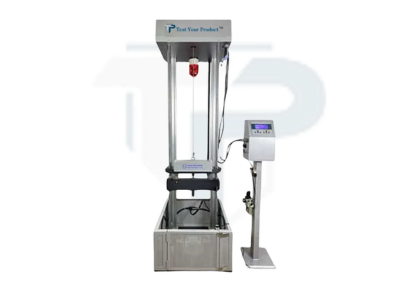
Toe Cap Impact Tester
The Shoes Impact Tester is used to determine the impact of resistance of safety shoes when a heavy object falls on them. This is done to ensure that the product is safe for the consumers and will protect their feet from accidents.
Product Details
| Parameter | Details |
| Product Name | Toe Cap Impact Tester |
| Purpose | Evaluates impact resistance and durability of toe caps in safety footwear |
| Application | Footwear industry, construction, manufacturing, and industrial settings |
| Impact Height | 0 to 1500 mm (Motorized or manual adjustment) |
| Striker Specifications | Wedge-shaped, 75 mm length, 90° angle, 20 kg |
| Impact Energy | 0 to 200 ± 2 Joules (Electromagnetic or manual) |
| Clamping Block Dimensions | 150 x 150 x 19 mm (Hardness: ≥ 60 HRC) |
| Base Block Dimensions | 400 x 400 x 40 mm |
| Safety Features | Interlocked safety guard, emergency stop |
| Control and Monitoring | Manual/PLC control, LED/digital display |
| Power Supply | AC 220V, 50 Hz, Single-phase |
| Dimensions and Weight | 700 x 600 x 1840 mm, ~229 kg |
| Compliance Standards | ISO 20344, EN 12568, ASTM F2412, ANSI Z41 |
| Measurement Accuracy | High test accuracy with microprocessor-controlled display |
| Material Compatibility | Steel, composite, and aluminum toe caps |
| Calibration | In-built calibration for high accuracy |
| Applications | Quality assurance, regulatory compliance, and design improvement |
| Test Type | Impact resistance and durability testing |
| Test Method | Simulates impact with weighted hammer or pendulum |
| Safety Compliance | Meets international safety footwear standards |
| Main Industries | Construction, manufacturing, oil & gas, warehousing |
| Display | LED/Illuminated display for better visibility |
| Advantages | Ensures safety, meets compliance, and enhances product design |
| Additional Features | Adjustable clamps, safety interlocks, and emergency stop |
| Testing Standards | ASTM F2413, ISO 20345, EN 12568 |
The Toe Cap Impact Tester evaluates the durability and impact resistance of toe caps in safety footwear. The machine simulates the type of impact and stresses toe caps are subjected to in heavy-duty environments like construction sites and industrial settings. By testing and examining the action under controlled impacts, this tester helps manufacturers ensure that their footwear provides the kind of protection required for the toes to prevent injury from falling objects or other potential hazards. The test also guarantees that the toe caps remain intact under normal working conditions, ensuring the safety and longevity of the footwear.
How Toe Cap Impact Tester Works:
The Toe Cap Impact Tester is operational by positioning the safety footwear toe cap into the equipment. Upon this testing cap, a mechanical arm carrying a pendulum or hammer that is weighted strikes with a predetermined amount of force, which mimics what might happen to the footwear under real-life conditions of impact. That force is measured in an electronic or mechanical manner and recorded to determine the capability of the toe cap to absorb the impact without cracking, breaking, or deforming.
The reaction of the toe cap is monitored by the tester as the impact force is applied, thus verifying the failure or deformation point of the material. This study is vital in providing an insight into how the toe cap can adequately shield the foot from possible injuries, thus providing essential information on the material's strength and durability.
Toe Cap Impact Tester Advantages:
The Toe Cap Impact Tester offers many advantages to manufacturers and safety footwear companies:
- Exact Measurements of Impact Resistance: The test provides a measure of the impact force the toe cap can withstand, ensuring the footwear provides sufficient protection.
- More Definitely Safe: Testing toe caps offers assurances to protect the workers from dangers arising from foot injuries in places like construction sites, factories, and Warehouses.
- Industry Compliance: The Toe Cap Impact Tester is the crucial tool that ensures manufacturers comply with standards set by the industry like ASTM and ISO that describe the minimum requirements for impact resistance of safety footwear.
- Better Design Decisions: Once manufacturers have available detailed design information regarding impact resistance, they can make better design decisions on toe caps and therefore select materials that will give maximum protection as well as comfort
- Guaranteed Quality: This tester guarantees that every single pair of shoes is qualified, thereby reducing the risk of faulty products reaching the market.
- Price and Time Efficient: Testing impact resistance before mass manufacturing saves a lot of money and prevents losses owing to non-defective products that cannot conform to safety standards.
Applications:
Toe Cap Impact Testers are applied all over different industries:
- Manufacturing Safety Footwear: Guarantees toe caps' strength and safety in all footwear models intended for industrial sites and hazardous use.
- Construction and Industrial Fields: Assurance of protecting workers' feet against heavy impacts or falling objects.
- Quality Control and Testing Facilities: Evaluation through third-party laboratories focusing on the impact resistance of safety shoes in modeling the quality assurance pathway.
- Assuring Products Meet Regulatory Standards: Helping manufacturers make sure their products meet regulatory standards necessary for safety and protection.
| Impact Height | 0 to 1500 mm (Motorized or manual adjustment) |
| Striker Specifications | Wedge-shaped, 75 mm length, 90° angle, 20 kg |
| Impact Energy | 0 to 200 ± 2 Joules (Electromagnetic or manual) |
| Clamping Block Dimensions | 150 x 150 x 19 mm (Hardness: ≥ 60 HRC) |
| Base Block Dimensions | 400 x 400 x 40 mm |
| Safety Features | Interlocked safety guard, emergency stop |
| Control and Monitoring | Manual/PLC control, LED/digital display |
| Power Supply | AC 220V, 50 Hz, Single-phase |
| Dimensions and Weight | 700 x 600 x 1840 mm, ~229 kg |
| Compliance Standards | ISO 20344, EN 12568, ASTM F2412, ANSI Z41 |